Hey U.S., Who Are Our Neighbors?

The party in political power at the moment has asserted a reinterpretation of Jesus’ and the Bible’s teachings about our neighbor. Who the neighbor is, and what our responsibility to them is in relation to our responsibility to ourselves and our closest circles of family and community. We see it being played out in executive action and legislative inaction. On January 29, 2025, Vice President JD Vance in a Fox News interview said, “There is a Christian concept that you love your family and then you love your neighbor, and then you love your community, and then you love your fellow citizens, and then after that, prioritize the rest of the world. A lot of the far left has completely inverted that.”

No, there isn’t s biblically based Christian concept like that, Mr. Vance. There are many issues that can be seen differently but this is not one of them. Neither Jesus nor the Bible in general have any ambiguity on this issue. In fact, biblically speaking, asking whether there is an order to our responsibility is the wrong question to ask. The question isn’t “who first?” but “who needs us?” We are directed to love others, and yes that can be hard and require sacrifice on our part, but it is intrinsic to the life and faith of Jesus and the message of the Bible. Let me walk us through a few places in the Bible where this is made clear.

Jesus’ parable known as The Good Samaritan told in Luke’s Gospel (Luke 9.25-37) speaks directly to this. It starts with an expert on the law, someone who teaches and explains the Torah in the synagogue, coming to Jesus to test him. He asks what he must do to inherit eternal life. The word ‘test’ suggests that he was there to try to trip up Jesus. And Jesus characteristically turns the question back to the man. “What does the law say? How do you read it?” To which the man answers “You shall love the Lord your God with all your heart and with all your soul and with all your strength and with all your mind.” This comes right from the Torah he is the expert on. That love mentioned doesn’t mean to just adore God, but to align with God’s ways, be in right relationship with God, or to use biblical language, be righteous in God’s eyes. Then he adds another bit of the Torah as if it were part of the former, “and [love] your neighbor as yourself.” Loving oneself is affirmed but not as an end to itself, it is a model for loving the neighbor.

Jesus tells him he got it right, “You have given the right answer; do this, and you will live.”

That leaves some wiggle room though. After all, those strangers far away, or new to my community aren’t really neighbors, right?! And that is exactly the question the man returns to Jesus, “Who is my neighbor?” The story tells us he asks this to justify or vindicate himself. Perhaps that means to get himself off the hook for the implications of what he just said the Torah, the Bible, says. Regardless of his motives Jesus’ answer has the same message, and he answers with a story, a parable.

The story is likely familiar. A man was on the road out of Jerusalem and was mugged. Stripped, robbed, beaten and left in the ditch. Two people pass by – both Jews. A priest and a Levite. People of authority in the religious and civic life of the time. They pass by ignoring the man. Then the parable tells us a third came by, a Samaritan. Samaritans aren’t Jews and, to use modern terms, are highly polarized from the Jews. Of the three, this is the one we would least expect to help, but he does. The Samaritan tends to him, inconveniences himself, pays for his care and follows up with him.

At the end of the parable Jesus asks, “Which of the three was a neighbor to the man who was robbed?” The man of the law not quite able to say the name “Samaritan” says, “The one who showed him mercy.” To which Jesus says simply, “Go and do likewise.” [It is worth noting that Jesus doesn’t say, “Wait and do likewise, if someone with need shows up.” Jesus says “Go!” He calls us to action. He sends us out to seek and serve the brother or sister in need.]

Jesus defines neighbor as the person, known or unknown by us, near or far. Simply put, everyone. And he defines the nature of our relationship with our neighbor: Care for them. Not if it is convenient, not if we have everything of our own fully taken care of. No, “Love your neighbor just like you would love yourself.” A command that is repeated in Matthew and Mark’s gospels, and in Romans, Galatians, and James. Love the outsider, love the needy, whoever they are, just like you would love yourself. That is a reflection of loving God with your heart, soul, strength, and mind.

This teaching of Jesus isn’t meant to take away from self-care, nor be an excuse for neglecting our own family or community. Rather it is there to remind us of the larger family we are inextricably part of. God’s family.  

Let’s look at another familiar story from Jesus. As he is teaching he talks figuratively about The King, God, who speaks to those who have either done or not done what he willed them to do (Matthew 25.31-46). They were asked to ‘feed the hungry, give a drink to the thirsty, welcome the stranger, clothe the naked, care for the sick, visit the imprisoned.’ He ends by telling his listeners and us, “Just as you did it to one of the least of these brothers (and sisters) of mine, you did it to me.” The ‘least’ of my people; the most trivial, insignificant of them. No conditions. In prison rightly or wrongly. Familiar or stranger. Deserving or undeserving. They all count, they are all neighbors, God’s people, our family. There is no order among them giving preference to those nearest you genetically or geographically. After all, according to Jesus’ story it is The King, God, whom we are loving when we do this.

We can reach into the Old Testament and find this theme played out repeatedly as well. God doesn’t prioritize the powerful or the familiar over others. More often the Bible gives a seat at the table to one whom others wouldn’t expect, understand, or like; Joseph, Moses, David to name a notable few. After all, Israel itself was made up of the least among the people of their day, and Good loves, provides, and executes justice for the outsider as this passage from Deuteronomy (10.17-19) records.

For the LORD your God is God of gods and Lord of lords, the great God, mighty and awesome, who is not partial and takes no bribe, who executes justice for the orphan and the widow, and who loves the strangers, providing them food and clothing. You shall also love the stranger, for you were strangers in the land of Egypt.

We can cite example after example of this basic recognition and value of the stranger, like in Paul’s letter 1 Corinthians 10.24  “Do not seek your own advantage, but that of the other, the neighbor” but the best witness is God and Jesus themselves. “For God so loved the world (read everyone and everything), that God gave his only son…” (John 3.16) No prioritization or protection for those close to oneself in God’s love there! God so loved seemingly others that he gave up what was closest. Wow! And then there is Jesus. He was a model of self-sacrifice for humanity. He gave a gift to all people – that includes you, it includes me – of what was closest and most precious, his life.

As individuals, and as a nation, do we care for our own first, and then those close to us, and if there is enough, then others too? Is it the responsibility of those closer to them to care for them, not ours?

Or do we seek to help the marginalized, the poor, the disadvantaged? Do we welcome the stranger? The latter is what Jesus did, and his word to us, “Go and do likewise.”

10 years is a long time

2015-2025

That’s how long it’s been since my last post. Well, 9 years and 5 months to be precise. Close enough. Over those years I’ve been writing – a lot! – but not here and it’s time to take the Precarious Pastor up again.

In the meantime a lot has changed. Politically and societally, yes, but mainly in me. No abrupt changes, but a continued progression of the course I’ve been on since at least high school. A course I fully committed to when I started Jacob’s Well in South Minneapolis in 2006 which become Fabric in 2018 with the intent of creating a church that was people, not a building. Community, not an institution. A church focused on weaving significant relationships with each other, the larger world, and that ‘whatever it is’ that transcends everything and anything we could ever grasp. No belief statements to conform to, but openness, curiosity, and persistence to explore, test it, and put it to work in our lives and relationships. I won’t detail those changes, I’ll let them become apparent in the posts that follow.

The 124 posts in this blog reflect my thoughts from that time, and while I might not write them the same way today, I still stand by their core ideas. I encourage you to read them with an understanding of the context in which they were created. Observing evolution and change—perhaps even growth—is just as valuable as making everything fit current standards.

I suppose it is relevant to fill in some of the 10-year gap by sharing that I retired from leadership of Fabric in 2024 and placed it in the able hands of the community, staff, and a new leader, Ian McConnell. They are doing great work and finding the way Fabric is meant to be woven with this new configuration of hands at the loom. While that role has been relinquished my responsibility to speak out has not. So just where, and about what is something I am exploring. Thanks for reading. Follow and subscribe to this blog if you will and share your thoughts in the comments.

Thanks. Now, let’s shake things up!

In your Comfort Zone? It’s time to grow!

Comfort-Danger.AnxietyWith Jacob’s Well Minneapolis we’re talking “Because It Hurts” (Sept 2015)
We’re digging into those necessary and important parts of life that unavoidably hurt from time to time. We have no illusions about avoiding the pain, or somehow justifying it, but we do believe that when we help each other live in and through the pain it makes us more alive – even when it’s killing us.

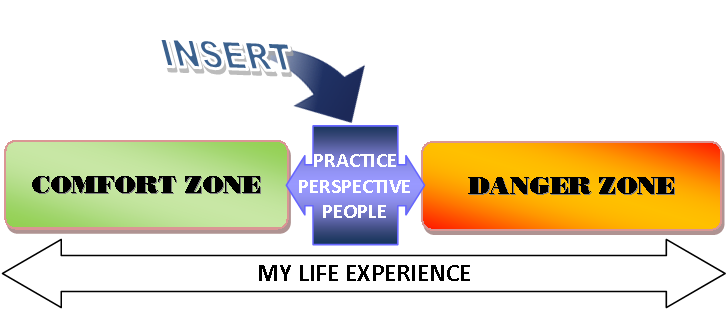
One of the key things we are talking about is the relationship between our Comfort Zone and our Danger Zone. [Last week we called the Danger Zone our “Safety Zone” meaning that this is where my safety seems threatened, but that was confusing, so we’re switching “Safety Zone” to “Danger Zone.”]

When we spend too much time in our Comfort Zone we don’t grow much. And we are also ill-prepared for life outside our it – which is inevitable. And, like the diagram above, we find that when we leave our Comfort Zone we are immediately thrust into our Danger Zone and our reaction is Panic! Anxiety! It’s not fun. Not much growth happens there either. And it hurts.

What we need is to create some space between our Comfort and Danger Zones.

We do it by inserting Personal Practices that help us avoid the panic that paralyzes us. Gaining Perspective about what life is really like and about. How threatening the challenge really is. It’s seeing, and feeling, the big picture. I would say this is bringing God and wisdom into the situation. And inviting People to be part of the experience with you. This is the most important piece actually because it is through people you most often find the strength to learn and practice what you need, and that God gives you glimpses of the larger perspective you need.

When you bring Practices, Perspective and People into your life you interrupt the Comfort<=>Danger Zone chain reaction and develop a Growth Zone.Comfort-Danger.GrowthZone

Sure, your Growth Zone is pretty scary too, hurt is part of the equation of life after all, but you aren’t in your danger zone! You can do this. And you can take that hurting stuff and… grow! In fact while you may be uncomfortable, scared and uncertain in your Growth Zone (with practices, perspective and people at work in it with you) you may find yourself surprisingly, but not so strangely, experiencing peace.Comfort-Danger.Peace

You’ll also notice that your Danger Zone is shrinking – not so many things trigger panic anymore. Your Comfort Zone is expanding – things you could never have done before are now part of what you do everyday. And your Growth Zone is a place that you long for – in it’s bittersweet way you realize that this is where you are most alive.

Jesus’ Work

Real & Ideal Work @ Jacob's Well MinneapolisThe Jacob’s Well Minneapolis community has been talking about the ‘healthy real & ideal’ in order to keep the ‘unhealthy’ versions of them at bay. We talked about Real & Ideal Work yesterday (4/13/2014). Here are a few thoughts from it. It starts with a parable that was written by someone from our community especially for this day.

The kingdom of heaven is like a woman who looks in the mirror in the morning, touches up her hair, smiles and says, “Today I will make the world a better place” as she heads off to work. She does that every day.

Yesterday was Palm Sunday as the regular church calendar goes. That was the day Jesus entered Jerusalem for the Feast of the Passover, it was going to be the last week of his life. It was the week when he observed the Passover Meal with his disciples, was arrested that night, hung on a cross to die the next day, and then Sunday, Easter, is the day we celebrate his resurrection.

You know how I see what was going on with Jesus in all this? All of this was his work. When he entered into Jerusalem on that day we now call Palm Sunday everyone saw him as the superstar, he knew better. He wasn’t seduced with stardom, he knew it was an unhealthy idealization of the work he had to do. He wasn’t afraid of it either; he didn’t fall victim to despair by looking at the reality of his work in an unhealthy way. He knew what he was doing mattered. He had chosen to do it. I get this sense that Jesus was extraordinarily clear about what his work was – it was to love. To love us. You, me, everyone. Why? Purely because he did and he couldn’t turn it off. It didn’t matter if it was hard or it was easy, it didn’t matter if he liked doing it all the time or didn’t. It was the work that he had chosen and so like that woman who looked in the mirror each morning, touched up her hair and went forth ready to make the world a better place, Jesus was going to love us because he felt from the bottom of his heart that he was doing the right thing for the right reason.

Maybe that first Good Friday, when Jesus was killed, was really just another day at the office for him. He was just doing what he knew he was supposed to do. It wasn’t a matter of being hard to do, or easy. It wasn’t a matter of liking it or not. It was a matter of doing the work he knew he had been called to. And so he stretched out his arms and loved us with everything he had… just like he had always done.

What is your work? Choose it. Transform it if you must, but do it and live into it. Turn it into the power of God at work in the world, and in you. Remember, you GET to do this!


The Elephant in the Room – Week 2 Text Messages & Notes

Continuing our Jacob’s Well series on “The Elephant in the Room.”

Image

Here are the text messages and notes people sent in during the service yesterday (11/17). See the input from last week’s service here. Leave comments or more ‘elephants’ below.

  • Is the Bible to be taken as literal truth or parable stories to learn from?
  • The entire book of Revelation x2; do we apply it today?
  • How does the Bible fit into today’s world – in whole or in part?
  • Do you need to be SMART to interpret the bible or ACCEPTING?
  • Heaven and hell – can we take it literally that it exists? Is there a heaven?
  • Justin mentions the bible was written by goat herders. What about revisions (with bias) made overtime by monks/priests through handwritten translation?
  • Since the bible is written by “man” is it ok to view the bible as flawed as “man” is flawed?
  • Are you unchristian if you have sex before marriage? Even when ur young?
  • Is it our job to evangelize or lead by example?
  • Is there only one religion of god (Christianity? Related: Is Jesus the only “son” of god?)
  • Can Christianity exclude anyone (x2), and if it did, is it still Christianity?
  • Is Atheism bad?
  • If I tell someone I’m a Christian, it associates me with a lot of people I don’t like. How do I deal with that?
  • How to reconcile what the Bible teaches about Jesus being THE only way into God’s kingdom and a personal belief or conviction that people outside of Christianity are welcome, too?
  • Christians can’t “accept” other faiths/religions as full truth as well.
  • Why do people feel a need to tell others that they are wrong?
  • If God created everything – both good and bad – it’s my belief that then everything is for a reason. With that said, what is the reason that there is such a divide in the Christian faith? Are those with another opinion of God wrong? Is there a wrong? If not how do I deal with those that call themselves Christian, but don’t align with what I believe God is?
  • I have a hard time truly grasping that Jesus was truly the son of God…really? And came back to life? Really? I sometimes wonder if I can really be Christian if I struggle to believe this.
  • Why is it necessary to define oneself as a Christian? And how does the culture of worship interfere with Truth?
  • Did Jesus become the son of God? What if God is a human construct and what is wrong with that?
  • How did god impregnate Mary from heaven?? How is Jesus the son of god if Mary and god didn’t actually have sex? I’m confused.
  • How is Jesus’ death and resurrection any less “fantastical” than old testament stories that work best as a metaphor?
  • If Jesus was born Christ, isn’t it impossible to be life him? If he became Christ, the shouldn’t we expect ourselves to live better lives. If god is all that is, isn’t god more like quantum physics? How do you love quantum physics?
  • So many wonderful questions, so little time. Thank you for the chance to wrestle with them so openly. I’ve wondered why we don’t talk about the Holy Spirit more here. I could talk about/listen about Jesus & God forever, but I’m not sure what to think about the Holy Spirit. Such a minor point, really, but it keeps niggling at me…P.S. I find it easier actually to be loved by the stars in the sky?
  • Why do good Christians have to suffer in health areas? What is God’s purpose in sickness?
  • Disease. Famine.
  • Why do bad things happen? Suffering, war, hunger…
  • I don’t understand war! It’s been around since the beginning. What does it ever prove?
  • Why do the people with the least often receive more than their fair share of hardship? (i.e., Philippines)
  • Why does God allow for so much suffering in the world?
  • Sometimes love and grace can be so big that sin and injustice almost become irrelevant. What the hell happens with Hitler?
  • Why do bad things happen if god can control almost everything?
  • Who goes to heaven, the afterlife or whatever it is after the death of the body. What about your Jewish, Muslim, Atheist friends
  • We don’t pray together every day. If I don’t pray in the morning or evening I feel undisciplined and not a good Christian.
  • I wrestle with my sins in Galatians Chapter 5: 13-15. Will we be forgiven for our sins? Or not?
  • Hearing God’s voice – how to decipher it it’s God.
  • I’ve been spiritual and in tune to God up until now. Now, in middle age God is completely gone to me. I’m pretty much a non-believer. Why would God “go?”

Thanks for all the thoughtful and honest questions. We responded in some way to many of them, but certainly can’t say we resolved them all. That is a lifelong task. My hope isn’t to answer them all, but to let everyone know that questions and doubts are healthy. They can build faith. They are dangerous, not when they are thought, but when they are buried away.

Faith in Everyday Life

Image

I was teaching a session of a Kairos course at Luther Seminary yesterday on “Faith and Everyday Life.” I began by telling them, “Faith In Everyday Life is a difficult thing for me to talk about because faith and everyday life isn’t something that we do at Jacob’s Well. [pause] It is the ONLY thing we do at Jacob’s Well. If something doesn’t relate to everyday life, we don’t bother with it. Why would we?”

If nothing else, it got everyone to look up from their screens. We then spent an hour talking about how we do it.

Teaching that class gave me a new way of looking at what I strive to be about. I know this is an ideal we don’t live up to all the time, but nonetheless I believe it is a fundamental commitment of our community [this goes way back, see this entry]. Why devote time, effort, money or staff at something that doesn’t make a difference in people’s lives? Churches get caught up with events, traditions, structures and activities that have achieved ‘sacredness’ other than helping people live their faith. That’s a problem. It happens naturally, but it is our job to continually ask, “Is this event, tradition, structure, event building community, equipping people, opening lives to the presence of God?” And if the answer is no, then it’s time to re-evaluate. 

What helps you connect faith and life? What aspects of “church” make it feel distant and foreign from everyday life?

The Elephant in the Room – Week 1 Text Messages

Image

Our community, Jacob’s Well, just started a focus for the next 3 weeks today entitled, “The Elephant in the Room.” We figure to be a healthy community we need to openly and honestly deal with them from time to time. We don’t expect to all agree about them or to resolve them all, but they really do lose their negative power over us when we do this.This week was called “The Rules are Dead. ALL of Them.” It was about… rules! You know, all those things people think they have to, or wonder if they need to do to be “Good Christians.” My take is that Jesus made it pretty clear that it isn’t about the rules, it’s about relationships. Relationships that free us to be who we really are, but tie us with bonds of responsibility.

The service was pretty conversational. Thanks to a couple of people who helped me talk about this complicated topic, Melissa Lock and Thaddeus Lesiak, and all the people who shared texts for us to add their thoughts and questions about “good Christian” rules. Here are some of them:

The Y’s and N’s were to these 3 questions:

1. Is God a God of rules?

2. Is the church a church of rules?

3. Is Jacob’s Well a community of rules?

TEXTS

  • 1. Y&N (God has expectations) 2. Some more than others. 3. N
  • Y, Y & N    3. JW has Guidelines, not rules. 1. God have us 10 commandments which are our rules. 2. Traditional Church is littered with Man’s arbitrary rules to ensure order and compliance.
  • Having to attend church on Sunday.
  • Rule: Everything in the bible is real and I must follow all those rules. Question: isn’t that ridiculous?
  • How can we know that our God is THE god?
  • What does “no one comes to the Father but by me?” Not a rule?
  • Do you have to give money to the church? They didn’t answer the question about giving money to the church. 🙂
  • “Real Christians vote Republican” versus “Democrats know what Christ’s love is really about.” How do you address “us vs them” within Christianity? How do we connect?
  • But do you need all of that to be a church… what if “church” wasn’t even just NOT having a building, but not gathering in conventional ways (with Sunday School programs, music, etc) but meeting out in the community on Sunday mornings and reaching out to the community, serving others as Jesus would, really experiencing what GOD is, who GOD is… is there a rule that you have to meet with music, a pastor to preach a message and Sunday School for kids – for us to be a church (isn’t a “church” defined differently in the bible – where one or more meet in my name – why do we have so many “rules” about what a valid “meeting” is).
  • Answer the wallet question. We skipped it.
  • Do you have to believe in God?
  • Rule: to be a Christian you have to go to church, be kind, generous, and never say or do mean or selfish things, or make poor choices.
  • Rule: You must read/know the Bible and pray regularly.
  • I have a lot of questions! To be a Christian, you have to be ‘certain’, no doubt.

Relationships instead of Church?

Read this article from Kathy Lynn  Grossman of USA TODAY, “Relationships Are the New Religion for Many,” and tell me what you think. This is good Jacob’s Well conversation.Easter PostCard jacob's well 2007

I think the article’s observations are right on, the conclusion isn’t.              [It really reminds me of some elements of our message  yesterday. (3.24.2013)]

My analysis says that “church” has failed to deliver value or relevance to people at their gatherings (worship services and more) for so many decades that we now have whole generations who have no idea that the church might actually have any. What people still have is the relationships that once found amazing, empowering, loving context in being church, and so they gather around those relationships instead. And for the most part “church/religion/the institution” continues to gather those who are left around nostalgia for what doesn’t connect.

How will we teach those looking for more that there is more when so few are trying to reclaim what church can be?

Notes taken while re-inventing church – 04

Take God seriously. Really seriously. Take your theology less so. 

Wedges, squares or more. It's still pizza.

Wedges, squares or more. It’s still pizza.

This is heresy to some of my doctrinally-oriented sisters and brothers, but I don’t consider myself dogmatically-handicapped, just conceptually-flexible. Here’s the deal: our theology only describes what we know and understand about God, it doesn’t prescribe what God has to be like.

A little humility is needed here. I was just reading the last four chapters of Job in preparation for preaching and was reminded by God’s booming voice coming out of the whirlwind that even in our most profound moments, we don’t know squat. At our best we reflect back, in our limited, human way, what we pick up from God.

The theological pizza can be sliced in more than one way; wedges, squares or more, it’s still pizza. That doesn’t mean there aren’t better ways or more faithful ways to understand and talk about God, it just means that none of them ARE God. They are all human constructs trying to capture to something that they can only point at.

So what does that mean?

  1. Don’t let your theology or theological traditions limit your experience with God. Expect God to mess with them; stretch them; make you rework them. If you don’t think this applies to you, you’ve parked the car of your faith journey while the world is flying by.
  2. Be open to other people’s experiences and expressions of God. Their ideas don’t have to be ‘right’ (nobody’s are, remember!) to be an authentic voice for their wrestlings with God right now, and for you to learn something from.
  3. Value your doubts and tough questions and experiences as God’s way of helping you do #4.
  4. KEEP GOD BIG! Theology is a box, not the thing itself. We need its categories and explanations to be able to deal with and talk about God, but we need to remember that God doesn’t, can’t ever fit in it. So take the initiative yourself to find the bigness of God that breaks your system. This may be painful but you’re on the way to a breakthrough, not a breakdown!

Notes taken while re-inventing church – 03

The numbers game is one of the trickiest in the God world (aka church). There are at least three pieces to this dynamic.

1. We all say it isn’t about ‘how many’, but we all compare our ‘how many’ and feel either inferior or superior because of it. Some of us more than others.

2. Then there is the sustainability dilemma. If the church is going to support itself it takes enough people to make that feasible. But then it isn’t about making money, or guaranteeing an income for the pastor and other staff.  

3. On the more positive side we know that we have a responsibility to grow in both depth and breadth. Not one or the other.

As you evaluate your ministry try dealing with the numbers game this way: Numbers are important. They let you know some very important things about the sort of systems and resources needed. The numbers help you set goals that match your vision and calling. And they tell you whether your ministry is growing or shrinking. Remember, the answer to “Why?” is the important piece to this.

But while that bigger number is important, the key number is always ‘one.’ Never take your focus off of the individual. What is each person’s experience who enters your doors, who attends a small group gathering, who is encountered at a service event, who has a crisis in their life and needs your community’s ministry, who is met by a person shaped by your community? Who are you for the person standing right in front of you, right now? There is no such thing as the community’s experience, or the neighborhood’s reaction to your church. It is the experience and reaction of each individual. Build, equip, structure your community to be about the number that always comes first, one.